A Question That Refuses to Go Away
When people talk about politics today, they often sound cynical. States, we are told, care only about power. Morality is dismissed as public relations. Compassion is seen as weakness. However, this view raises an important question that remains unanswered. If power is the only reality, why do societies demand fairness, justice, and accountability from their governments at all? The very fact that people feel betrayed when leaders act without ethics suggests that something deeper is expected from a state.
This tension sits at the center of modern political life.
The Power Only View of the State
Many assume that states exist only to protect interests through force. History provides numerous examples that support this view. Empires rose and fell through conquest. Dictatorships maintained order through fear. Even today, some regimes survive by suppressing dissent rather than earning the trust of their people.
From this perspective, ethics are optional. They are useful when convenient and ignored when they threaten control. Stability comes from strength, not values. This idea has shaped much modern thinking about international politics.
However, this explanation is incomplete.
The Idea of an Ethical State
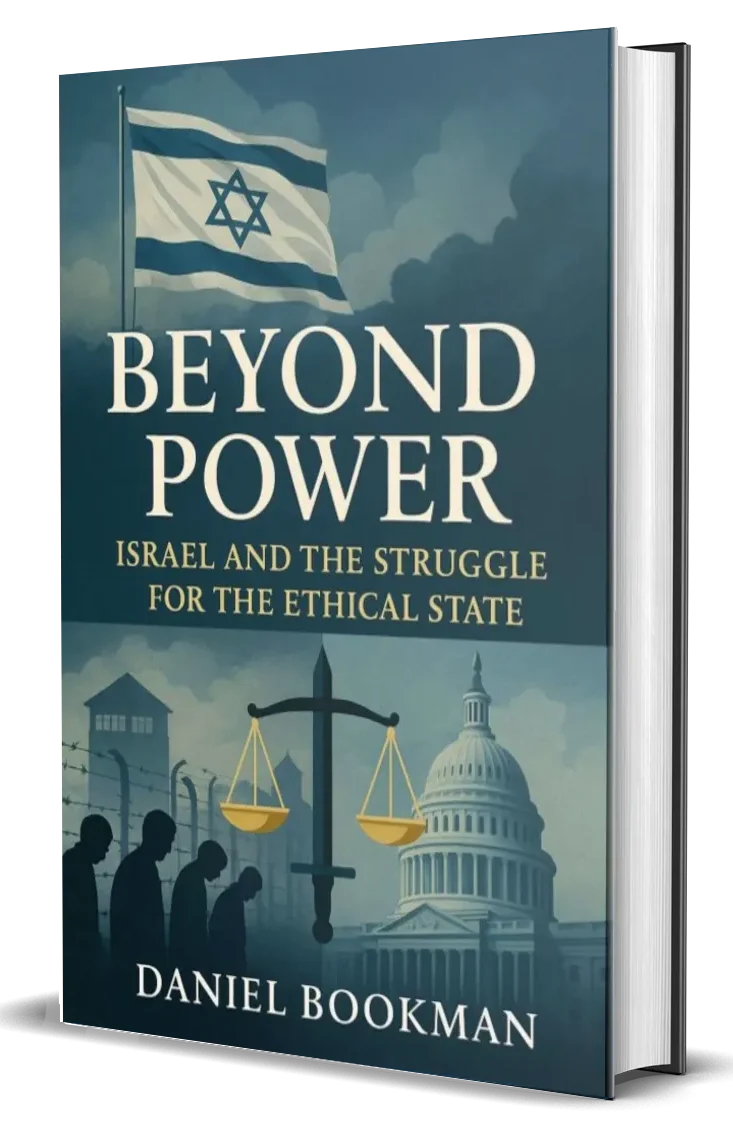
In Beyond Power: Israel and the Struggle for the Ethical State, Daniel Bookman argues that some states aim to be more than instruments of control. They seek legitimacy through responsibility rather than fear.
An ethical state does not abandon power. It limits it. Authority is exercised within moral boundaries that protect human dignity and respect. Laws apply to leaders as well as citizens. Institutions exist to serve the public rather than dominate it. This model does not reject strength. It disciplines it.
Why Democracies Depend on Ethics
Democracies cannot function solely on power. Voting systems, courts, and free speech rely on trust. Citizens accept laws because they believe those laws are meant to serve the common good. When that belief fades, democracy weakens.
Examples of ethical erosion are readily apparent. When leaders excuse corruption, people stop believing in the concept of fairness. When public debate turns hostile and dishonest, trust collapses. When institutions prioritize ideology over truth, citizens disengage. These failures are not technical. They are moral.
A state may still appear strong during this decline, but its strength becomes brittle and fragile. Power without ethics creates obedience, not loyalty.
What Happens When Ethics Are Lost
History shows that states that abandon moral limits eventually rely more heavily on force. Surveillance expands. Dissent is treated as a threat. Enemies are invented to justify control. This pattern is observed in authoritarian systems across various cultures.
Even democracies are not immune. When political success becomes the only goal, principles are bent. Short-term victories replace long-term responsibility. Over time, citizens sense the change. They lose confidence not only in leaders but in the system itself.
That is why the ethical foundation of a state matters as much as its military or economy.
Israel and the Ethical Challenge
The book uses Israel as a case study because it highlights this tension clearly. Israel operates under constant threat yet remains accountable to law and public scrutiny. Its existence challenges the idea that survival requires abandoning ethics. This challenge unsettles power-based systems that view moral limits as a weakness.
A Choice Still Being Made
Can a state be ethical? History suggests it can, but only with effort. Ethics do not sustain themselves. They must be defended, taught, and renewed.
For readers who wish to explore this idea more deeply, Daniel Bookman’s Beyond Power: Israel and the Struggle for the Ethical State offers a clear and thoughtful framework. It asks difficult questions without slogans and reminds us that power alone has never been enough to build a society worth preserving.
Read this book now, available on Amazon: https://www.amazon.com/dp/B0G1D4N83H/.